



The UAE Fellowship is a structured professional pathway that reshapes your relationship with the profession, from practice that relies on experience alone to practice grounded in clear standards, regulatory awareness, and stronger confidence in professional judgment.
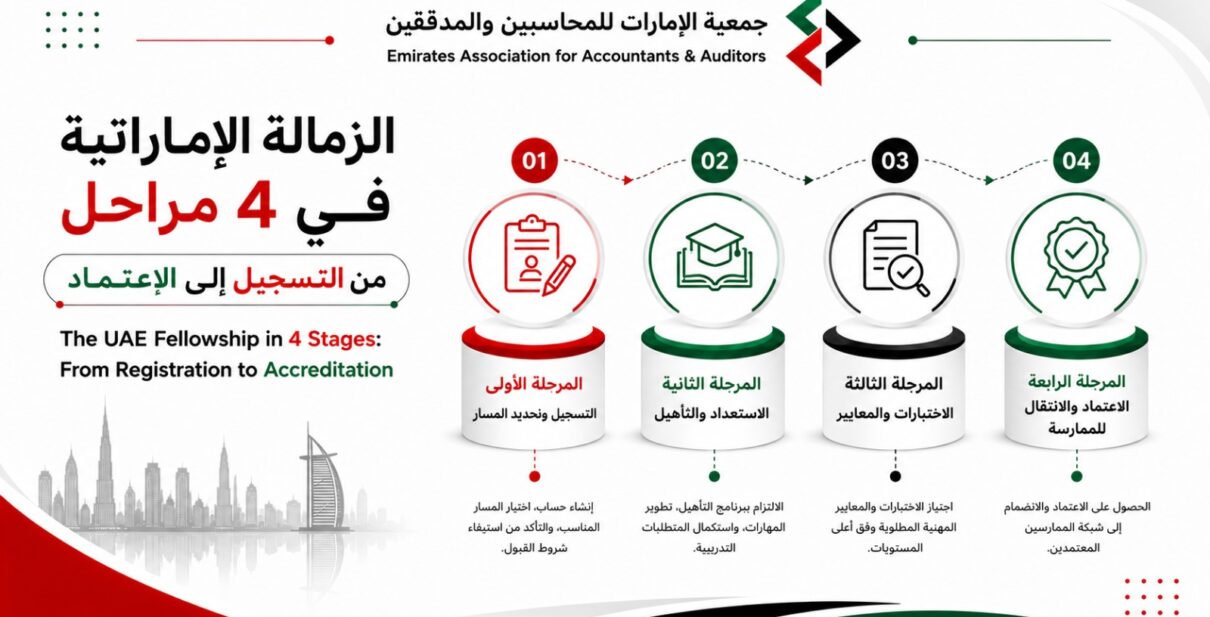
And because any pathway of this kind can become exhausting if approached randomly, the best way to make the journey easier is to view it as four stages. Each stage has a goal, key outputs, and common mistakes, avoiding them can save you significant time and effort.
Table of Contents
- Why is the Fellowship a professional pathway, not just a certificate?
- Stage One: Registration and choosing your pathway
- Stage Two: Preparation and readiness building
- Stage Three: Exams and standards
- Stage Four: Accreditation and transition into practice
- Common mistakes that delay candidates—and how to avoid them
- Frequently Asked Questions (FAQ)
1) Why Is the Fellowship a Professional Pathway, Not Just a Certificate?
The difference between a “certificate” and a “pathway” is that a pathway changes your day-to-day professional behavior:
- It raises your level of understanding of standards (accounting and auditing).
- It connects your work to regulations and tax within a clear framework.
- It creates a shared professional language between you, the job market, regulators, and clients.
That’s why the value of the Fellowship is not measured only by what happens after the exams, but also by what happens before them: preparation, discipline, and turning knowledge into application.
2) Stage One: Registration and Choosing Your Pathway
This is the “right decision” stage. Many candidates start with enthusiasm, then struggle because they have not clearly defined:
- Why am I starting the Fellowship now?
- What is a realistic timeline for me?
- What do I need before entering the exams?
What should you do at this stage?
- Review the admission criteria and core requirements in full.
- Define your professional goal:
- Are you targeting external audit?
- Financial accounting and reporting?
- Compliance and governance?
- Set an initial timeline: Can you prepare for one exam every 8–12 weeks, or do you need a slower pace?
- Check whether you may qualify for exemptions (some professional qualifications may allow exemptions from the first two exams, subject to applicable rules).
How do you save time here?
- Don’t begin studying before you understand the number of exams, what each one covers, and what your plan for each exam looks like.
- Don’t set a “perfect” schedule—set a schedule that is realistic alongside your work.
3) Stage Two: Preparation and Readiness Building
This is the “readiness-building” stage. The goal is not only reading—it is building a study system.
A practical preparation model (without complexity)
- Week 1: Understand the exam map + distribute topics + identify weak areas.
- Weeks 2–6: Structured study + summaries + weekly practice questions.
- Weeks 7–8: Focused revision + mock exams + improved time management.
The role of Continuing Professional Development (CPD)
Specialized workshops and courses help you to:
- Turn concepts into practical applications.
- Understand updates faster instead of long individual searching.
- Maintain a consistent learning rhythm that does not break.
4) Stage Three: Exams and Standards
This is the decisive stage, because the Fellowship is based on three exams covering three core areas:
- Accounting standards
- Auditing standards
- Regulations and taxation
Important note: The passing score is not less than 60% for each exam, and exemptions may apply for certain professional qualifications from the first two exams, subject to the applicable rules.
How do you manage your time here?
- Don’t wait for “100% readiness.” Use early mock tests to identify gaps.
- Define clear outputs for each exam:
– Short summaries
– A list of difficult topics
– A question bank
– A final-week revision plan
5) Stage Four: Accreditation and Transition into Practice
After completing the requirements, you enter the stage that transforms the Fellowship from an achievement into real market value.
What does “transition into practice” mean?
- Applying standards in working papers and daily reporting.
- Improving documentation quality and professional risk management.
- Building a stronger professional identity—within your organization, an audit firm, or the broader market.
How do you multiply the Fellowship’s impact after accreditation?
- Link it to an annual CPD plan: two specialized topics + one topics focused on regulations/updates.
- Participate in specialized workshops/committees/events to keep your professional presence active.
- Make the Fellowship part of your professional profile: CV, LinkedIn, and professional bio.
6) Common Mistakes That Delay Candidates and How to Avoid Them
- An unrealistic plan: Studying 10 hours a day alongside work is not sustainable. Set a stable minimum (e.g., 5–7 hours per week).
- Reading without practice: Questions are not the final stage; they are a diagnostic tool from the beginning.
- Too many resources: One core reference + a question bank + your own summaries.
- Not linking study to practice: For each topic, ask yourself: “How does this show up in my work?”
- Leaving regulations and tax until the end: This is a separate exam area and requires early preparation.
- Not using CPD effectively: Some workshops can save you weeks of self-study.
7) Frequently Asked Questions (FAQ)
Is the Fellowship suitable for professionals outside audit?
Yes. It strengthens understanding of standards and regulations and reflects on reporting, governance, and compliance within organizations.
Can I start without long experience?
The foundation is readiness and discipline. Start with a realistic plan and support it with training courses that strengthen CPD.
What is the minimum passing score?
The passing score is not less than 60% for each exam.
Are there exemptions?
Exemptions may apply for certain professional qualifications from the first two exams, subject to the approved rules.
Conclusion
The UAE Fellowship journey becomes much easier when you view it as four clear stages:
Registration and pathway selection → Preparation and readiness → Exams → Accreditation and practice.
Real timesaving does not come from forcing long study hours, but from a realistic plan, early practice, focused resources, and using CPD as a learning accelerator.