



The UAE has become one of the region’s strongest business hubs because companies can operate in a market that combines international connectivity, developed financial infrastructure, and clear regulatory expectations. For this reason, auditing is not only a technical requirement; it is part of how companies build trust with investors, lenders, regulators, shareholders, and business partners. Any company that wants to grow responsibly needs to understand auditing standards in UAE and how they affect financial reporting, governance, and risk management.
This guide explains auditing standards in UAE in a practical way for business owners, finance teams, auditors, and foreign investors. It covers why audit standards matter, the framework used by auditors, the role of regulators and professional bodies, key audit areas in Dubai and UAE free zones, and the wider impact of audit quality on businesses and the national economy.
The Importance of Auditing Standards in the UAE
Auditing standards in UAE are important because they create a consistent basis for how financial statements are examined, how evidence is evaluated, and how audit opinions are formed. In a market that includes mainland companies, free zone entities, listed companies, family businesses, government-related entities, financial institutions, and multinational groups, consistency matters. Without a recognized audit framework, every auditor could apply a different approach, which would reduce the reliability of financial information.
The UAE’s audit environment is shaped by federal laws, ministerial decisions, international professional standards, and sector-specific regulators. The Ministry of Economy lists key legislation for the auditing profession, including Federal Decree-Law No. 41 of 2023 concerning the regulation of the accounting and auditing profession. The Ministry’s published legislation also includes decisions related to the implementation and regulation of auditing practice.
1.1 Ensuring Financial Integrity Across the UAE
Auditing standards in UAE help ensure that financial statements are supported by sufficient evidence and prepared in a way that reflects the business reality of the company. For business owners, this reduces the risk of relying on inaccurate numbers. For boards and shareholders, it improves oversight. For banks and investors, it supports better credit and investment decisions.
Financial integrity is especially important in a diversified economy. Companies in trading, real estate, construction, logistics, manufacturing, technology, financial services, hospitality, and professional services all face different financial risks. A high-quality audit process helps identify whether revenue, expenses, assets, liabilities, related-party transactions, provisions, and disclosures are properly recorded and presented.
1.2 Strengthening Investor Confidence in the UAE
Auditing standards in UAE also support investor confidence. Investors do not only look at revenue growth or market opportunity; they look at whether the financial information can be trusted. A properly audited financial statement gives investors more confidence that the company’s numbers have been reviewed against a recognized professional framework.
This is particularly important for companies seeking bank finance, private investment, mergers and acquisitions, public listing readiness, or expansion into international markets. Strong audit practices reduce uncertainty and make it easier for stakeholders to compare one company with another. In a market like the UAE, where many companies operate across borders, the credibility of audited financial information becomes a business advantage.
1.3 Improving Corporate Governance Practices in the UAE
Auditing standards in UAE support corporate governance by clarifying the responsibilities of management, auditors, boards, and audit committees. Management is responsible for preparing financial statements and maintaining internal controls, while the auditor provides an independent opinion based on audit work performed under professional standards.
Good governance is not limited to large public companies. SMEs, family businesses, free zone companies, and privately held entities also benefit from clear reporting, documented controls, and independent review. As companies grow, weak governance can create problems in cash flow, tax compliance, bank financing, succession planning, fraud prevention, and decision-making. Audit discipline helps reduce these risks before they become expensive.
The Framework of Auditing Standards in the UAE
Auditing standards in UAE are based on a combination of international audit standards, UAE professional regulation, accounting standards, ethical requirements, quality management expectations, and sector-specific rules. This combination allows the UAE to align with global practice while also addressing local regulatory needs.
The framework is not only about the audit opinion at year-end. It includes auditor registration, professional competence, independence, audit documentation, risk assessment, evidence gathering, communication with management, reporting requirements, and quality control. For businesses, this means the audit should be treated as a structured process, not as a simple administrative formality.
2.1 International Standards on Auditing (ISA) Applied in the UAE
Auditing standards in UAE are strongly connected to International Standards on Auditing. Ministerial Decision No. 403 of 2015 states that auditors shall apply International Accounting Standards, International Standards on Auditing, the profession’s ethics and code of conduct, quality control, and International Financial Reporting Standards.
ISA provides a professional approach to planning and performing an audit. It requires auditors to understand the business, assess risks of material misstatement, design audit procedures, obtain appropriate evidence, evaluate internal controls where relevant, and form an audit opinion. This protects users of financial statements from unsupported or superficial audit work.
For companies, ISA-based audits require preparation. Management should have organized accounting records, bank reconciliations, contracts, invoices, payroll records, inventory records, fixed asset registers, tax documentation, and explanations for major transactions. The stronger the company’s documentation, the smoother and more valuable the audit process becomes.
2.2 Regulatory Authorities Governing Auditing in the UAE
Auditing standards in UAE are supported by several authorities depending on the type of entity and sector. The Ministry of Economy plays a central role in regulating the accounting and auditing profession at the federal level. Public sector and government-related entities may fall under additional oversight depending on the emirate and the nature of the entity. Financial institutions may be subject to regulations issued by the Central Bank of the UAE, including financial reporting and external audit requirements designed to establish minimum acceptable standards for reporting and audit practices.
In Abu Dhabi, the Abu Dhabi Accountability Authority describes its role as promoting accountability, transparency, and integrity across Abu Dhabi government entities and institutions in which the Abu Dhabi government has a vested interest of more than 25%. ADAA also provides audit services that include compliance and performance audits to verify compliance with laws and assess operational efficiency and effectiveness.
This regulatory landscape means companies should not assume that one general rule applies to every entity. A mainland trading company, a listed entity, a regulated financial institution, a free zone company, and a government-related entity may each face different audit and reporting requirements.
2.3 Professional Bodies Supporting Auditing in the UAE
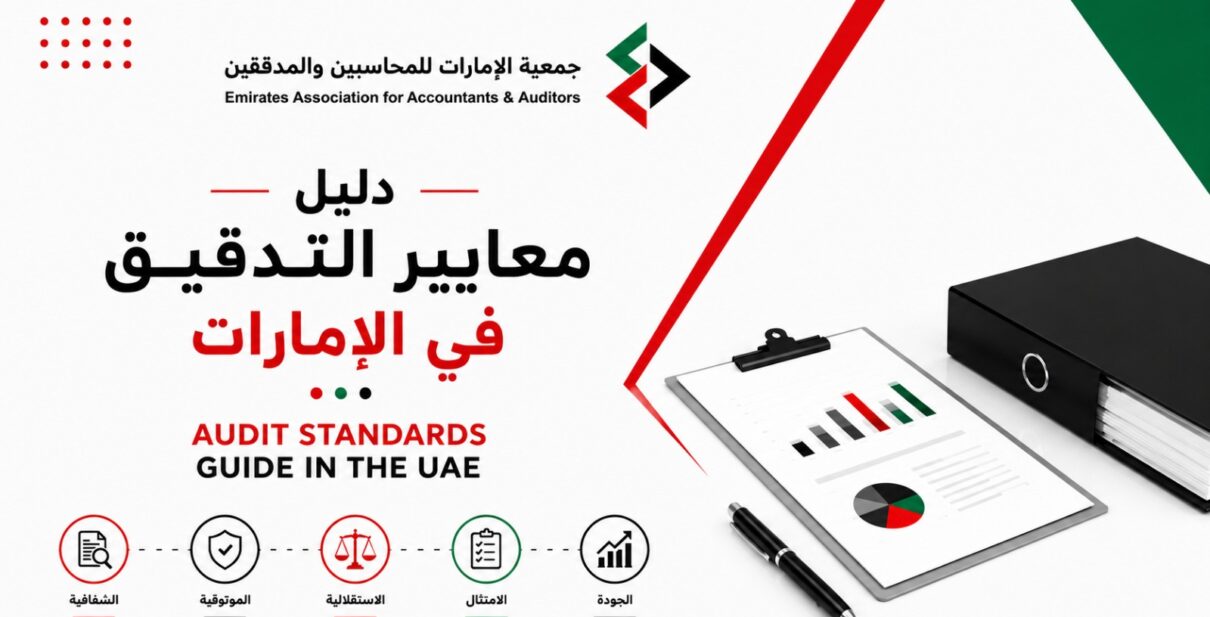
Professional bodies play an important role in developing knowledge, ethics, technical competence, and continuing professional education. The Emirates Association for Accountants and Auditors presents itself as the UAE’s national society dedicated to the accounting and auditing profession, promoting high standards of practice and ethics, professional development, economic growth, and transparency.
Businesses and professionals can also review EAAA membership categories to understand how professional membership supports accountants, auditors, firms, and finance professionals in the UAE. For auditors, technical knowledge alone is not enough. The profession also requires independence, ethical awareness, professional skepticism, and regular development.
Professional bodies help connect regulation with practice. They support training, professional qualifications, events, guidance, and technical discussions that help accountants and auditors respond to changing standards, tax requirements, sustainability reporting, digital systems, and governance expectations.
Key Areas of Auditing Standards in Dubai and UAE Free Zones
Auditing standards in UAE are relevant across Dubai, Abu Dhabi, Sharjah, other emirates, mainland entities, and free zone companies. However, audit obligations may differ depending on the company’s legal structure, free zone authority, license requirements, tax status, and shareholder needs.
Dubai and UAE free zones attract companies from around the world. Many free zone entities are created for regional trade, holding structures, consulting, logistics, technology, finance, and services. While free zones may have different administrative procedures, audit quality remains important for renewal, banking, tax compliance, shareholder reporting, and business credibility.
3.1 Ethical Requirements for Auditors in Dubai and UAE Free Zones
Ethics are central to audit quality. An auditor must remain independent, objective, and professionally skeptical. If an auditor has a financial interest in the client, personal relationships with management, or pressure from the client to ignore evidence, the audit opinion loses credibility.
Ethical requirements protect both the auditor and the company. They help ensure that the audit is not influenced by management pressure, commercial dependence, gifts, conflicts of interest, or inappropriate familiarity. In practice, this means audit firms should evaluate independence before accepting or continuing an engagement. Companies should also avoid asking auditors to approve weak documentation, overlook errors, or act as management.
3.2 Quality Control Requirements for Auditing in the UAE
Auditing standards in UAE require more than completing a checklist. Audit firms need internal quality processes that guide engagement acceptance, staff assignment, supervision, review, consultation, documentation, and reporting. A quality audit is planned, reviewed, and supported by evidence.
Quality control is especially important when a company operates in a complex sector, has multiple branches, uses inventory systems, relies heavily on estimates, or has related-party transactions. Weak audit quality can lead to missed errors, incorrect reporting, regulatory concerns, and reputational damage.
For entities subject to Abu Dhabi Accountability Authority oversight, ADAA’s published standards for auditing financial statements refer to International Standards on Auditing, review engagements, assurance engagements, and quality control issued by relevant international boards. ADAA’s internal audit rules also require internal audit units to develop a manual that clarifies methodology, policies, and procedures under a unified operational framework.
3.3 Financial Reporting Standards in the UAE
Audit quality depends heavily on the accounting framework used to prepare financial statements. If accounting policies are weak or inconsistent, the audit becomes more difficult and the financial statements become less useful. Accounting Standards in the UAE are closely connected to IFRS and IFRS for SMEs for corporate tax purposes.
Ministerial Decision No. 114 of 2023 states that taxable persons shall apply International Financial Reporting Standards, and that eligible taxable persons may apply IFRS for SMEs when revenue does not exceed AED 50 million. The same decision also allows the cash basis of accounting in certain cases, including where revenue does not exceed AED 3 million or in exceptional circumstances based on an application to the Federal Tax Authority.
The IFRS Foundation’s jurisdiction profile also notes the use of IFRS requirements for companies listed on major UAE markets and financial centers, including Nasdaq Dubai, entities under DFSA listing rules, and Abu Dhabi Securities Exchange, with further detail on the use of IFRS in UAE capital markets.
3.4 Specialized Audit Sectors in the UAE and Dubai Free Zones
Some sectors require more specialized audit attention than others. Banks, insurance companies, listed entities, government-related entities, investment firms, real estate developers, charities, and regulated free zone entities may face additional reporting, governance, or compliance requirements.
Specialized sectors often involve higher risks, such as complex financial instruments, regulatory capital, client money, restricted funds, valuation uncertainty, large contracts, public funds, or sustainability-related disclosures. In these cases, auditors need sector knowledge, technical expertise, and a clear understanding of the applicable regulator’s expectations. For entities under Abu Dhabi public-sector oversight, adaa regulations may create additional internal audit, accountability, performance, and reporting considerations.
The Impact of Auditing Standards on Businesses and the UAE Economy
Auditing standards in UAE have a direct impact on business quality and economic confidence. They help companies produce more reliable financial information, reduce risk, support financing, strengthen governance, and improve the overall transparency of the market.
At the national level, audit quality supports the UAE’s position as a trusted business hub. International investors and multinational companies often compare jurisdictions based on regulatory clarity, financial transparency, enforceability, reporting quality, and professional standards. A strong auditing environment contributes to these advantages.
4.1 Improving Financial Reporting Quality in the UAE
Better audits lead to better financial reporting. When auditors review revenue recognition, asset valuation, liabilities, provisions, related-party balances, going concern assumptions, and disclosures, they help management identify weaknesses and correct misstatements.
This does not mean auditors manage the company’s accounts. Management remains responsible for preparing the financial statements. However, a professional audit process challenges assumptions, tests evidence, and improves confidence in the final financial report. Over time, this encourages companies to maintain cleaner records and stronger internal processes.
4.2 Reducing Financial and Operational Risks in the UAE
Audits also reduce risk by identifying weaknesses in controls, documentation, approvals, reconciliations, inventory management, receivables collection, payroll processing, or related-party transactions. These weaknesses may not always result in immediate misstatement, but they can create future losses.
For growing companies, risk often increases faster than internal systems. A company may expand branches, hire more employees, add suppliers, enter new markets, or introduce online sales before strengthening finance controls. A proper audit can highlight gaps early and help management take corrective action.
4.3 Strengthening Market Transparency in the UAE
Auditing standards in UAE strengthen market transparency by making financial information more comparable, verifiable, and useful. When companies follow recognized audit and reporting practices, stakeholders can make decisions based on clearer information.
Market transparency benefits banks, investors, suppliers, customers, regulators, and employees. It also reduces the space for manipulation, weak disclosure, and unsupported financial claims. For the UAE, this transparency supports a stronger business environment and helps attract companies that value professional governance.
4.4 Supporting Global Business Integration for UAE Companies
UAE companies often work with international investors, lenders, suppliers, holding companies, and regulators. Strong audit practices make it easier for these companies to integrate into global business networks. When audited financial statements are prepared and reviewed under recognized standards, foreign stakeholders can better understand the company’s performance and financial position.
This is particularly relevant for groups that have subsidiaries in multiple countries, companies preparing for mergers and acquisitions, and businesses seeking external funding. Global partners often expect structured financial reporting, reliable audit opinions, and clear governance. Strong audit discipline helps UAE companies meet these expectations.
FAQ
What are auditing standards in the UAE?
Auditing standards in the UAE refer to the professional rules and frameworks auditors use when examining financial statements and forming audit opinions. They include international audit standards, ethical requirements, quality control expectations, UAE regulations, and sector-specific rules issued by relevant authorities.
Are International Standards on Auditing applied in the UAE?
Yes. International Standards on Auditing are part of the UAE audit environment. Ministerial Decision No. 403 of 2015 specifically refers to the application of International Standards on Auditing, along with international accounting standards, ethics, quality control, and IFRS.
Do all UAE companies need an audit?
Audit requirements depend on the company’s legal form, jurisdiction, free zone rules, sector, shareholder requirements, tax position, and banking needs. Some companies are legally required to submit audited financial statements, while others may need an audit for renewal, bank financing, investors, shareholders, or corporate governance reasons.
How do auditing standards differ from accounting standards?
Accounting standards guide how financial statements are prepared, while auditing standards guide how auditors examine those financial statements. In simple terms, accounting standards affect the numbers and disclosures, while auditing standards affect how those numbers and disclosures are checked.
Why should SMEs care about audit quality?
SMEs should care about audit quality because clean financial records support better decisions, bank finance, investor readiness, tax compliance, and growth planning. Even when an audit is not treated as a strategic tool, the audit process can reveal weaknesses in documentation, controls, cash management, and reporting.
Conclusion
Understanding auditing standards in UAE is essential for any company that wants to operate with credibility, transparency, and long-term discipline. Audit standards are not only relevant to auditors. They affect business owners, finance managers, boards, investors, banks, regulators, and anyone who relies on financial statements.
The UAE’s audit environment combines international standards, federal regulation, sector-specific oversight, professional bodies, and financial reporting requirements. For companies, this means audit preparation should begin before year-end. Strong accounting records, clear documentation, ethical governance, and early communication with auditors can reduce delays and improve the value of the audit.
In a competitive market, audit quality is not just compliance. It is a signal of trust. Companies that understand auditing standards in UAE and apply them properly are better positioned to access finance, attract investors, manage risk, and grow with confidence inside the UAE and beyond.