



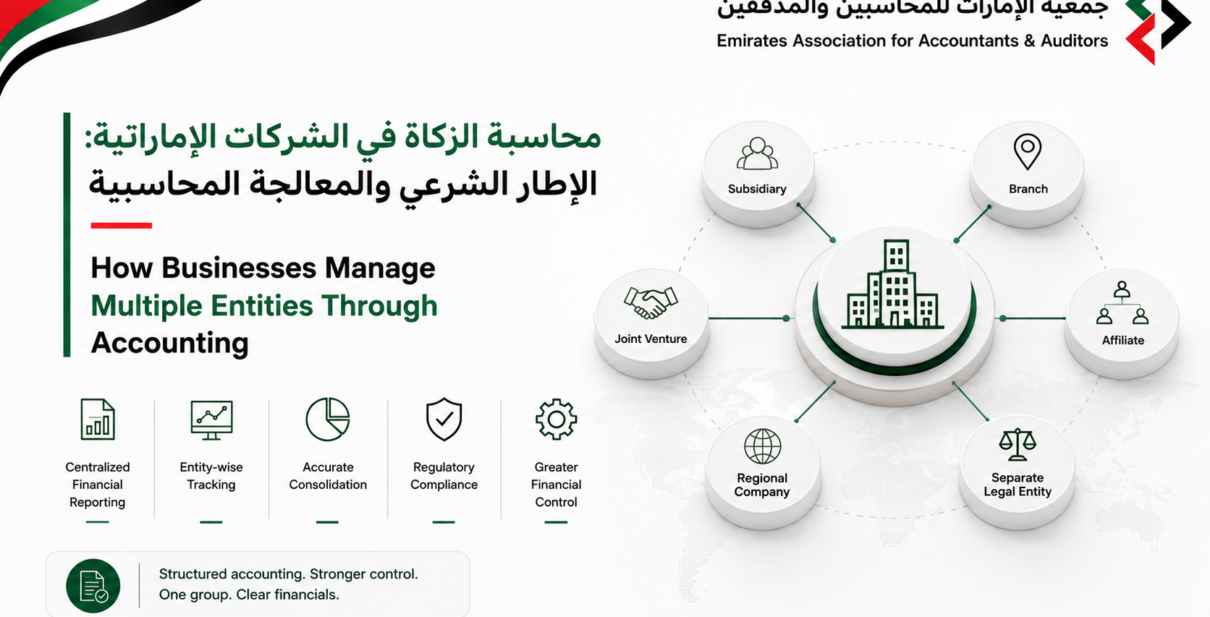
As businesses expand, they often establish subsidiaries, branches, regional companies, joint ventures, or separate legal entities to support different markets, products, ownership structures, or operational goals. Managing these organizations can become complex because each entity may have its own bank accounts, budgets, tax obligations, reporting requirements, and internal controls.
This is where multi-entity accounting becomes important. It provides a structured approach for recording, monitoring, and reporting the financial activities of several related entities while preserving the financial identity of each one. It also helps management understand both individual entity performance and the overall position of the wider business group.
Effective financial management across multiple entities requires more than maintaining separate ledgers. Businesses must also manage intercompany transactions, standardize accounting policies, reconcile balances, control access to financial information, and prepare accurate consolidated reports.
This article is intended for professional awareness and educational purposes. It does not replace professional accounting, tax, legal, or financial advice, and businesses should seek qualified advice based on their individual circumstances.
1- What Businesses Should Know About Multi-Entity Accounting
Multi-entity accounting refers to the management of financial records for two or more related entities within a business group. These entities may include subsidiaries, parent companies, branches, divisions, special-purpose entities, or companies operating in different jurisdictions.
Each entity usually maintains its own financial records because it may have a separate legal identity, management structure, ownership arrangement, or regulatory responsibility. At the same time, the parent company or group management often needs a combined view of performance.
This creates two parallel reporting needs:
- Separate reporting for each legal entity.
- Consolidated reporting for the wider group.
A proper structure allows the finance team to preserve the accuracy of each entity’s accounts while also preparing group-level reports. It prevents the financial activities of one company from being mixed incorrectly with those of another.
For example, a group may own one company that manages retail operations, another that owns property, and a third that provides logistics services. Each company needs separate income statements, balance sheets, cash flow information, and supporting records. However, group management may also need a consolidated view showing the total financial position of all companies.
The complexity increases when entities use different currencies, charts of accounts, reporting calendars, accounting policies, or software platforms. Without a consistent approach, finance teams may spend significant time collecting information, correcting classifications, and reconciling differences.
A well-designed multi entity accounting system can help organize these processes by allowing each entity to maintain separate records within a controlled financial environment. However, technology alone is not enough. Businesses also need clear policies, defined responsibilities, review procedures, and professional judgment.
2- How Businesses Manage Finances With Multi-Entity Accounting
Businesses use multi-entity accounting to coordinate financial activities across related companies without losing visibility over each entity.
The process normally begins with maintaining separate ledgers. Each entity records its own revenues, expenses, assets, liabilities, and equity. Transactions should be supported by appropriate documentation and recorded according to the accounting policies applicable to that entity.
The finance team then develops a standardized reporting structure. This often includes a common chart of accounts, consistent naming conventions, standard reporting periods, and agreed classifications for income and expenses.
A common chart of accounts is particularly useful. One entity may classify a cost as “administrative expenses,” while another may classify the same cost as “general overhead.” Standardization improves comparability and makes group reporting more efficient.
Another major area is intercompany accounting. Related entities frequently transact with one another. One entity may provide management services to another, transfer inventory, lend funds, allocate shared expenses, or collect money on behalf of another company.
These transactions must be recorded by both entities using consistent values and dates. If one company records an intercompany receivable, the other should normally record a corresponding payable. Differences may arise because of timing, currency conversion, missing documents, or inconsistent classification.
Regular reconciliation is therefore essential. Finance teams should compare intercompany balances before the reporting period closes. Outstanding differences should be investigated and resolved rather than carried forward without explanation.
Businesses must also control cash across the group. Some entities may generate surplus cash, while others may require funding. Management needs visibility over bank balances, short-term obligations, financing arrangements, and cash transfers between companies.
However, funds should not be transferred casually. Intercompany loans, management charges, and other financial arrangements may have accounting, tax, legal, or regulatory implications. Appropriate documentation and professional advice may be required.
Group reporting represents another key part of the process. Management may need reports showing:
- Revenue by entity.
- Profitability by company or region.
- Operating expenses across the group.
- Cash balances and borrowing levels.
- Intercompany balances.
- Consolidated assets and liabilities.
- Budget performance by entity.
Reliable reports allow decision-makers to evaluate individual companies while understanding their contribution to the wider group.
3- Why Multi-Entity Accounting Matters for Growing Companies
Growth often increases financial complexity faster than expected. A business that begins with one company may later create separate entities for new markets, investors, business lines, or risk-management purposes.
At this stage, multi-entity accounting becomes necessary because basic bookkeeping methods may no longer provide sufficient control.
One of its main benefits is improved visibility. Senior management can see which entities are performing well and which require attention. Without entity-level reporting, profitable operations may conceal losses in another part of the group.
It also supports accountability. Managers responsible for separate companies or divisions can be assessed using clearly defined budgets and financial results. This encourages more disciplined decision-making and reduces confusion over responsibility.
Another benefit is stronger financial control. Separate entity records help businesses identify unusual transactions, unauthorized costs, incorrect allocations, and unexpected balance movements. Standard approval procedures can also be applied consistently.
The approach also improves the quality of consolidated reporting. Group accounts should reflect the combined financial position of related entities while avoiding double counting. Transactions and balances between group companies may need to be eliminated during consolidation, depending on the applicable reporting framework.
For example, if one group company sells services to another, the seller records revenue and the buyer records an expense. At the individual entity level, both entries may be valid. At group level, however, the internal revenue and expense may need to be eliminated because the transaction occurred within the same economic group.
Growing companies also benefit from better planning. Management can prepare budgets for each entity and then combine them into a group budget. This helps identify funding needs, investment priorities, cost pressures, and operational dependencies.
In addition, lenders and investors may request financial information for both individual entities and the group. Clear reporting can improve the business’s ability to respond to due diligence requirements and financing discussions.
However, good reporting does not guarantee business success or regulatory compliance. It provides decision-makers with more reliable information, but that information must still be reviewed and interpreted by qualified professionals.
4- Examples of Multi-Entity Accounting in Real Business Operations
Multi-entity accounting can be applied in many industries and ownership structures.
Retail Groups
A retail group may operate separate legal entities in different emirates or countries. Each entity may have its own stores, employees, leases, suppliers, and bank accounts.
Management needs to compare sales, gross margins, inventory losses, operating costs, and profitability across locations. At the same time, the group may need consolidated reports for owners, lenders, or other stakeholders.
The finance team must also account for inventory transfers between related entities, shared marketing costs, central management charges, and intercompany balances.
Manufacturing Businesses
A manufacturing group may operate one entity for production, another for distribution, and a third for international sales.
The production company may sell finished goods to the distribution company. This creates intercompany revenue, inventory purchases, receivables, and payables. Transfer prices and related documentation may also require careful review.
At group level, management may want to understand manufacturing costs, inventory margins, logistics expenses, and final customer profitability without overstating revenue from internal sales.
Hospitality Companies
A hospitality group may own several hotels, restaurants, or serviced properties under separate companies.
Each entity may have different occupancy levels, payroll structures, food costs, maintenance expenses, and operating margins. Shared services such as human resources, procurement, marketing, or information technology may be provided centrally.
A consistent accounting process helps allocate these shared costs using a reasonable and supportable method.
Family-Owned Business Groups
Family businesses often operate multiple companies across sectors such as trading, real estate, construction, and professional services.
These groups may have complex ownership structures and frequent transactions between related companies. Clear records are particularly important for governance, succession planning, financing, and performance evaluation.
A disciplined accounting structure helps distinguish business expenses from personal or shareholder-related transactions and supports clearer management reporting.
Healthcare Groups
A healthcare group may operate clinics, laboratories, pharmacies, and administrative service companies.
Each entity may generate different types of revenue and incur different regulatory, staffing, equipment, and operating costs. Group management may need both entity-level financial information and consolidated performance reports.
International Operations
A company operating in more than one country may maintain entities with different functional currencies and local reporting requirements.
The finance team may need to convert financial information into a common reporting currency. It may also need to address exchange-rate differences and ensure that accounting policies are applied consistently across jurisdictions.
These examples show that the process is not limited to large multinational corporations. Any business with more than one legal entity may need a structured approach.
5- Key Steps for Successful Multi-Entity Accounting Management
Successful multi-entity accounting depends on process design, governance, and consistent execution.
Establish a Clear Entity Structure
The finance team should maintain an accurate list of all entities, including ownership details, legal status, reporting currency, financial year, bank accounts, and responsible managers.
This information should be updated whenever a company is created, acquired, sold, restructured, or closed.
Standardize the Chart of Accounts
A common chart of accounts allows similar transactions to be classified consistently. It also reduces the need for manual mapping when preparing group reports.
Some local accounts may still be necessary, but they should be linked to the group reporting structure.
Define Accounting Policies
Businesses should document how key transactions are recognized and classified. Policies may cover revenue, expenses, fixed assets, inventory, foreign currency, provisions, related-party transactions, and cost allocation.
Consistent policies improve comparability, although local legal or regulatory requirements may still require specific treatments.
Create Intercompany Procedures
The company should define how intercompany transactions are initiated, approved, invoiced, recorded, and reconciled.
Both sides of a transaction should use matching references, amounts, currencies, and reporting periods wherever possible. Disputes and timing differences should be resolved before the financial close.
Develop a Closing Calendar
A group-wide closing calendar sets deadlines for recording transactions, completing bank reconciliations, reviewing accruals, confirming intercompany balances, and submitting reports.
Clear deadlines help prevent one entity from delaying the entire consolidation process.
Assign Responsibilities
Each entity should have clearly identified individuals responsible for bookkeeping, review, approval, reconciliation, and reporting.
The group finance team should also define who reviews submitted information and who approves consolidation adjustments.
Strengthen Internal Controls
Access to accounting systems should be based on job responsibilities. Sensitive activities, such as creating suppliers, approving payments, and posting journals, should be appropriately controlled.
Where practical, duties should be separated to reduce the risk of error or unauthorized activity.
Review Data Quality
Before consolidation, businesses should check whether balances are complete, supported, and consistently classified.
Common review areas include:
- Unreconciled bank balances.
- Old receivables and payables.
- Unsupported journal entries.
- Unmatched intercompany balances.
- Incorrect currency rates.
- Unusual account movements.
- Missing accruals or provisions.
Document Consolidation Adjustments
All consolidation entries should be supported and reviewed. These may include intercompany eliminations, currency translation adjustments, or alignment with group accounting policies.
The purpose of each adjustment should be clear so it can be understood during management review or audit.
6- What Makes Good Multi-Entity Accounting Software?
Good multi-entity accounting software should support both separation and integration. It must preserve each entity’s financial records while allowing authorized users to access group-level information.
One essential feature is entity-level control. Users should be able to work within a specific company without accidentally posting transactions to another entity.
The software should also support consolidated reporting. Management should be able to review financial results by entity, region, department, business line, or group.
Intercompany functionality is another important consideration. A suitable system may help create matching entries, identify differences, automate recurring charges, and support balance reconciliation.
Currency management is particularly valuable for international groups. The system should allow transactions in different currencies and apply appropriate conversion methods for reporting purposes.
A strong solution should also include:
- Role-based user permissions.
- Audit trails.
- Standardized charts of accounts.
- Budgeting and forecasting tools.
- Financial dashboards.
- Document attachments.
- Approval workflows.
- Automated recurring entries.
- Integration with banking, payroll, inventory, or operational systems.
- Flexible reporting periods.
Ease of use is also important. A complex platform may fail if employees cannot use it consistently. Businesses should evaluate training requirements, implementation support, reporting flexibility, scalability, and total cost.
Data security and backup arrangements should be reviewed carefully. Financial systems contain sensitive information and should be protected through appropriate access controls, system monitoring, and recovery procedures.
Businesses should avoid selecting software based only on the number of features. The right solution should reflect the size of the group, transaction volume, reporting needs, internal resources, and future growth plans.
A multi entity accounting system can reduce repetitive work and improve visibility, but it does not replace financial controls or professional review. Automated reports can still contain errors if the underlying data is incomplete or incorrectly classified.
7- How the Emirates Association for Accountants and Auditors Supports Finance Professionals
Managing several entities requires accountants and finance professionals to understand financial reporting, internal controls, consolidation principles, governance, and the use of accounting technology.
The Emirates Association for Accountants and Auditors supports the development of the accounting and auditing profession by promoting professional knowledge, continuing development, and awareness of evolving practices.
Educational activities and professional development can help accountants strengthen their ability to manage complex reporting environments. This is particularly important as businesses expand, adopt new technologies, and operate through more sophisticated legal and operational structures.
Finance professionals should continue developing skills in areas such as:
- Consolidated financial reporting.
- Intercompany reconciliation.
- Financial systems and automation.
- Internal controls.
- Data analysis.
- Governance.
- Professional judgment.
- Communication with management and stakeholders.
The quality of financial reporting depends not only on software but also on the competence, ethics, and judgment of the professionals responsible for preparing and reviewing the information.
8- Final Thoughts
Managing several related companies requires a balance between entity-level accuracy and group-level visibility. Businesses must preserve separate financial records, control intercompany activity, standardize reporting, and produce reliable consolidated information.
Multi-entity accounting provides the structure needed to achieve these objectives. It helps management compare performance, monitor cash, evaluate risks, and make better-informed decisions across the organization.
However, the process should not be viewed as a software project alone. Successful implementation requires clear accounting policies, disciplined reconciliation, appropriate controls, reliable data, and qualified financial oversight.
As a business grows, the cost of weak financial coordination can also grow. Establishing strong processes early can reduce reporting delays, improve accountability, and support more sustainable expansion.
9- Frequently Asked Questions
What is multi-entity reporting?
Multi-entity reporting is the process of preparing financial information for several related entities. It may include separate reports for each company and consolidated reports for the wider group.
The reports may compare revenue, expenses, profit, cash, assets, liabilities, and budget performance across entities. Depending on the purpose of the report, internal transactions may need to be identified and eliminated.
Why would a company have multiple entities?
A company may establish multiple entities for operational, legal, investment, ownership, geographic, or risk-management reasons.
For example, a business may create separate companies for different countries, products, investors, properties, or operating activities. The structure should be designed with appropriate legal, tax, accounting, and governance advice.
What is multi-entity consolidation?
Multi-entity consolidation is the process of combining the financial information of a parent company and its relevant entities into group-level financial statements.
The process may include aligning accounting policies, converting currencies, combining account balances, and eliminating qualifying intercompany transactions and balances. The specific treatment depends on the applicable accounting framework and the relationship between the entities.
What is the difference between multi-entity and intercompany accounting?
Multi-entity accounting covers the broader management and reporting of financial information across several entities.
Intercompany accounting focuses specifically on transactions between related entities, such as loans, service charges, inventory transfers, shared costs, receivables, and payables.
In other words, intercompany accounting is one part of the wider multi-entity financial management process.
Can small businesses use multi-entity accounting?
Yes. Small businesses may need multi-entity accounting when they operate through more than one legal company, even if transaction volumes are limited.
The process does not always require an expensive or highly complex platform. A small group may begin with a controlled reporting structure, standardized accounts, regular reconciliations, and suitable accounting software. The level of complexity should match the business’s size, risks, and reporting needs.