



Professional ethics for accountants in the UAE form the foundation of financial trust across one of the most dynamic economic hubs in the world. Every audit opinion, every tax return, and every financial statement signed in Dubai, Abu Dhabi, or Sharjah traces back to a code of behavior that distinguishes a licensed practitioner from a mere bookkeeper. Understanding this framework is not optional for anyone holding a valid UAE audit license.
Professional ethics for accountants are the binding principles of integrity, objectivity, professional competence, confidentiality, and professional behavior that govern every licensed accountant and auditor practicing in the United Arab Emirates. These principles, codified in the International Ethics Standards Board for Accountants (IESBA) Code and enforced locally by the Emirates Association for Accountants and Auditors (EAAA) under Ministerial Resolution 111-2 of 2022, shape how financial work is performed, reviewed, and reported.
Understanding Professional Ethics in Accounting and Auditing
Professional ethics for accountants go beyond technical skill. A practitioner who masters IFRS but fails the integrity test produces reports no investor can trust. In the UAE context, where free zones, Mainland jurisdictions, and financial centers like DIFC and ADGM operate side by side, ethical consistency is the single quality assurance layer keeping the system coherent.
The profession stands on two pillars: technical competence and moral accountability. Competence can be measured in exams. Accountability can only be demonstrated through daily practice. The EAAA treats ethical training as equal in weight to technical training within its Continuing Professional Development (CPD) curriculum, ensuring each member renews both simultaneously.
Why Ethics Matter More in Regulated Economies
The UAE moved from a voluntary professional framework to a mandatory one with Ministerial Resolution 111-2 of 2022. Every auditor licensed by the Ministry of Economy must now join EAAA to practice. When licensing is compulsory, the weight of professional ethics for accountants multiplies. An unethical auditor no longer affects one firm. They undermine the credibility of the national audit system itself.
The IESBA Code and Its Application in the UAE
The IESBA Code sits at the heart of professional ethics for accountants across IFAC member bodies worldwide, and the EAAA adopted it as the national benchmark after joining IFAC as an Associate Member in 2021. This alignment means a UAE auditor follows the same ethical framework as a chartered accountant in London, New York, or Tokyo.
The IESBA framework introduces the Conceptual Framework approach. Instead of listing every possible ethical violation, it asks the practitioner to identify threats, evaluate their significance, and apply safeguards. This model respects the reality that no rulebook can anticipate every situation a UAE auditor encounters in a mixed jurisdiction environment.
Five threats auditors must recognize under the IESBA framework:
- Self-interest threat: a financial or other interest that could inappropriately influence judgment.
- Self-review threat: reviewing work previously performed by the same practitioner.
- Advocacy threat: promoting a client’s position to a point that compromises objectivity.
- Familiarity threat: long or close relationships with a client reducing professional skepticism.
- Intimidation threat: pressure from a client deterring objective action.
For each threat, the UAE auditor must either eliminate it or apply safeguards reducing it to an acceptable level. When no safeguard works, withdrawal is the only defensible option. For every UAE auditor, grasping the IESBA framework is the starting point of understanding professional ethics for accountants as an operational system rather than an abstract ideal.
Role of EAAA in Enforcing Ethical Standards
According to the EAAA profile on the IFAC website (February 2025 update), the association is committed to implementing Statements of Membership Obligations across six key areas, with significant progress recorded in ethics enforcement and Code of Ethics adoption. Enforcement is where professional ethics for accountants stop being theory and start having teeth.
The EAAA fulfills its enforcement role through three mechanisms:
| Mechanism | Purpose | Authority Source |
| Membership Investigation Committee | Reviews complaints against members | Ministerial Resolution 111-2 of 2022 |
| Investigation and Discipline (I&D) System | Fully developed in 2024 to comply with IFAC obligations | IFAC SMO 6 |
| CPD Ethics Modules | Mandatory ethical training hours within the annual 30-hour requirement | Ministry of Economy regulation |
The Membership Investigation Committee, established in April 2023, holds authority to impose disciplinary penalties ranging from public warning to suspension or termination of membership. Because membership is mandatory for licensed auditors, termination equals the end of a practitioner’s career in the UAE audit sector.
The Two-Tier Accountability Model
UAE auditors face two parallel accountability systems. The Ministry of Economy controls the license to practice. The EAAA controls the license to be called a professional. A practitioner can formally keep their MoE registration but lose the ability to serve clients if professional integrity in accounting is publicly questioned by the association.
Investigation and Discipline Framework for Ethical Violations
Before 2023, the UAE relied on cross-referenced discipline through ACCA and other international bodies. That changed with Ministerial Resolution 111-2 of 2022. The EAAA now operates an independent I&D process aligned with IFAC SMO 6, and professional ethics for accountants became directly enforceable within UAE jurisdiction for the first time. The auditor code of conduct is now a domestic matter, not an outsourced one.
How the investigation workflow moves:
- Complaint intake: any stakeholder files a written complaint with the Membership Investigation Committee.
- Initial screening: the committee verifies jurisdiction and completeness.
- Formal investigation: evidence collection, member response, and witness statements.
- Deliberation: the committee reviews findings against the IESBA Code and EAAA bylaws.
- Decision: ranging from dismissal to termination of membership.
- Appeal window: the member may contest the decision within a defined timeframe.
- Publication: significant outcomes are published to signal enforcement reality to the market.
This workflow runs on transparent procedures rather than closed-door judgments, matching the IESBA expectation of public interest protection.
Core Principles Every UAE Accountant Must Follow
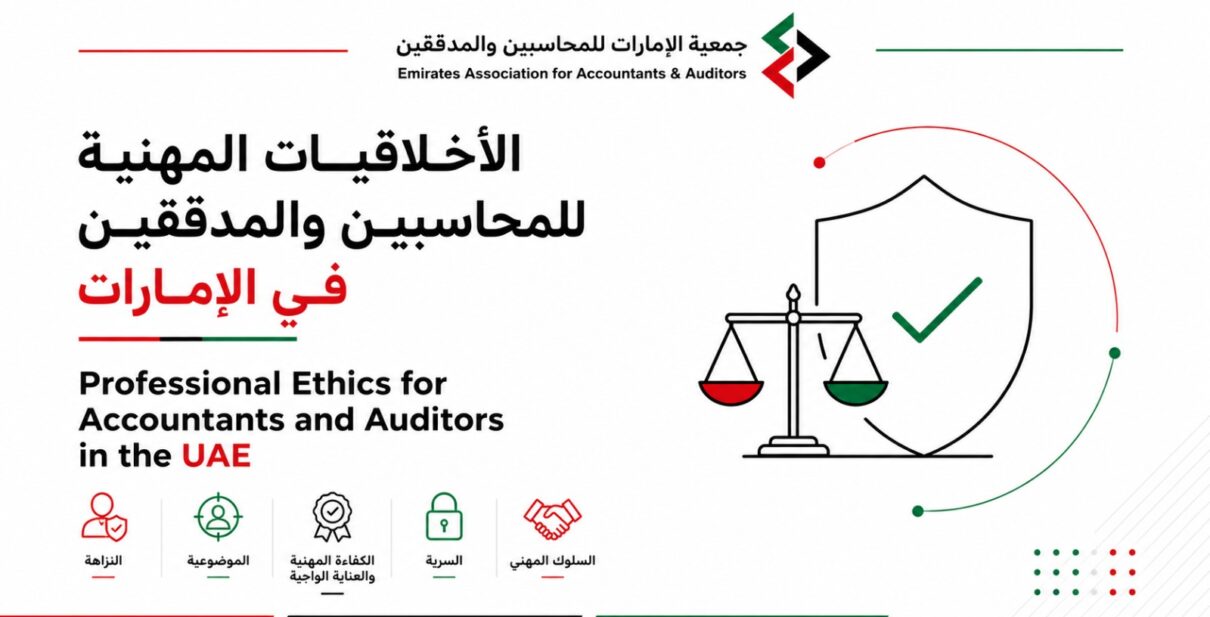
Professional ethics for accountants rest on five fundamental principles the IESBA Code defines and the EAAA enforces. Each principle is not a suggestion but a commitment every member signs on joining. These are the non-negotiables of the profession.
The five fundamental principles:
- Integrity: straightforwardness and honesty in all professional relationships. An accountant cannot associate with information they know to be materially false or misleading.
- Objectivity: no bias, conflict of interest, or undue influence may compromise professional judgment.
- Professional competence and due care: members maintain the knowledge and skill required at the level clients reasonably expect, and they exercise the diligence the situation demands.
- Confidentiality: information acquired through professional relationships stays within that relationship, except where legal or professional duty requires disclosure.
- Professional behavior: compliance with relevant laws and avoidance of conduct that discredits the profession.
These principles translate differently depending on whether the auditor works in a free zone, a Mainland firm, a DIFC-registered entity, or the public sector. The accounting code of ethics recognizes this and provides application guidance by sector.
Building an Ethical Culture in UAE Accounting Firms
Firm-level culture determines whether the IESBA Code shapes daily work or lives only in orientation manuals. Small offices with five members and Big Four branches in Dubai face the same fundamental question: how is professional ethics for accountants reinforced between audits, not only during them?
Practical culture-building steps that work in UAE firms:
- Document a firm-level ethics policy referencing the IESBA Code and EAAA bylaws, updated annually.
- Run quarterly case-based discussions where staff analyze anonymized ethical dilemmas.
- Establish a confidential internal reporting channel for suspected violations.
- Include ethics performance in annual review criteria, not only technical output.
- Appoint an Ethics Partner or Ethics Officer with clear escalation authority.
- Link CPD planning to identified ethical weak points from the prior year.
Firms that skip these steps comply on paper. Firms that implement them develop the kind of practice quality IFAC highlights in its international case studies.
The Signal the Market Reads
In 2024, the EAAA’s Investigation and Discipline developments were highlighted on IFAC international platforms as a successful case study. That visibility matters. International investors and cross-border firms reviewing UAE partners now see a discipline system that is not hypothetical. Ethical standards for auditors in the UAE carry credibility because enforcement is documented, not merely declared. Review the full regulatory context on the EAAA Governance page.
Continuous Ethical Development Through CPD Programs
The Ministry of Economy requires every licensed auditor to complete 30 CPD hours annually, and the EAAA delivers 12 of those hours specifically, covering IFRS, ISA, and local tax legislation. Ethics modules sit inside this mandatory curriculum, ensuring professional ethics for accountants are refreshed annually, not memorized once and forgotten.
The association planned to integrate International Education Standard 8 (IES 8) requirements into the CPD curriculum, targeting members who operate as engagement partners in audit firms. Engagement partners carry the heaviest ethical exposure because they sign opinions. Elevating their ethics training is not optional when the IESBA framework explicitly demands it.
What effective CPD ethics training covers:
- Recent IESBA pronouncements and interpretations.
- UAE-specific application of global principles.
- Emerging ethical questions in AI-assisted auditing.
- ESG reporting ethics and the risk of greenwashing.
- Long-association threats and rotation policies.
- Threats arising from cross-jurisdictional engagements (e.g., free zone and Mainland overlap).
The EAAA catalog evolves year on year. A practitioner who attended the 2023 ethics modules cannot assume 2026 content mirrors what they covered. Regulatory updates, IFAC strategic decisions (such as those voted at the 2025 Mexico City Council meeting, where EAAA participated as a full member), and local legislation changes reshape the required content annually.
Conclusion
Professional ethics for accountants in the UAE are no longer a voluntary aspiration. They are a regulated, enforced, and internationally benchmarked standard maintained by the Emirates Association for Accountants and Auditors with the authority of the Ministry of Economy. The IESBA Code, the Investigation and Discipline system, and the mandatory CPD ethics modules form a coherent triangle that keeps the profession credible in a jurisdiction where trust in numbers drives investment.
For any accountant or auditor planning a career in the UAE, mastering this ethical framework and engaging with EAAA programs is no longer optional professional development. It is the license to operate. To explore the structured pathway into a regulated career, review the UAE Fellowship Program at EAAA.
Frequently Asked Questions
What is the IESBA Code of Ethics for professional accountants?
The IESBA Code is the international benchmark for professional ethics for accountants, issued by the International Ethics Standards Board for Accountants. It establishes five fundamental principles (integrity, objectivity, competence, confidentiality, professional behavior) and a conceptual framework for identifying and resolving ethical threats. The EAAA adopted it as the UAE national standard after the association joined IFAC as an Associate Member in 2021.
Who enforces professional ethics for accountants in the UAE?
The EAAA enforces professional ethics for accountants in the UAE through its Membership Investigation Committee, established in April 2023 under Ministerial Resolution 111-2 of 2022. The Ministry of Economy supports enforcement by linking audit licensing to EAAA membership, meaning an auditor found in violation can lose both their professional standing and their practical ability to serve clients.
What are the 5 fundamental principles of professional ethics in accounting?
The five fundamental principles defined by the IESBA Code and adopted by the EAAA are integrity, objectivity, professional competence and due care, confidentiality, and professional behavior. Each principle carries specific application requirements, and UAE auditors are expected to know how each one applies across Mainland, free zone, and Financial Free Zone engagements.
What are the penalties for ethical violations in UAE auditing?
The EAAA Membership Investigation Committee can impose graduated penalties: private warning, public warning, suspension of membership, or termination of membership. Because EAAA membership is mandatory for auditors licensed by the Ministry of Economy, suspension or termination directly translates into inability to practice. Penalty decisions are published to maintain transparency with the market.