



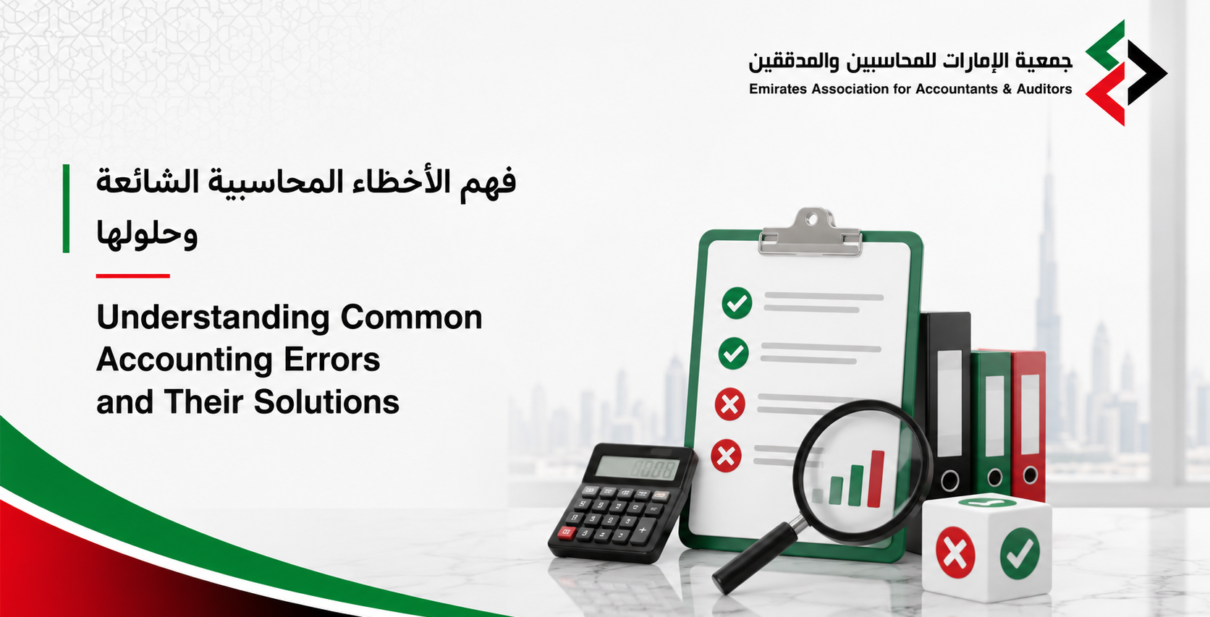
Accounting errors, even small ones, can quietly undermine the financial credibility of a business, distort reported profits, and create compliance headaches during tax filing or audit season. For accounting professionals across the UAE, understanding the different types of accounting errors and knowing how to identify and correct them is a fundamental part of maintaining accurate financial records. This article examines the most common accounting errors businesses encounter, why they matter, and practical steps organizations can take to prevent them. It also covers the specific accounting errors that affect the trial balance versus those that can slip through undetected, along with the different accounting errors types that finance professionals should be trained to recognize.
Different Types of Accounting Mistakes in Financial Records
Before examining specific categories, it is important to distinguish accounting errors from accounting fraud, since international standards treat the two very differently and the appropriate response depends entirely on which one applies. An accounting error is unintentional, arising from mistakes such as miscalculation, misapplication of accounting policies, or oversight in recording a transaction. Accounting fraud, by contrast, involves a deliberate act intended to obtain an improper benefit or to conceal the true financial position of a business, such as knowingly overstating revenue or hiding liabilities. This distinction matters because errors are typically addressed through correction and improved controls, while fraud raises separate legal, disciplinary, and reporting considerations that go well beyond a simple bookkeeping fix.
Accounting errors generally fall into several recognized categories, each with distinct causes and consequences. Errors of omission occur when a transaction is left out of the accounting records entirely, such as an invoice that was never entered into the system. Errors of commission happen when a transaction is recorded but with an incorrect amount, such as entering 5,000 instead of 500 due to a typing mistake.
Errors of principle arise when a transaction is recorded in violation of accepted accounting principles, such as recording a capital expenditure as a revenue expense. Compensating errors occur when two or more accounting errors offset each other, making the trial balance appear correct even though underlying mistakes exist. Understanding these distinct categories of accounting errors helps finance teams diagnose the root cause of a discrepancy more efficiently rather than searching blindly through the entire ledger.
Some accounting errors that affect the trial balance are relatively easy to detect, since they cause debits and credits to no longer match. Others, particularly errors of principle and compensating errors, can pass through a trial balance completely unnoticed, since the total debits and credits still balance despite the underlying entries being incorrect. This distinction matters considerably for how thoroughly a business needs to review its records beyond a simple trial balance check.
There is also a useful distinction between errors that affect a single account and those that affect multiple accounts simultaneously. A single transaction posted to the wrong expense account, for example, may still leave the trial balance in balance while quietly distorting departmental cost reporting. Businesses that only review overall trial balance accuracy, without examining individual account detail, can miss this category of error for extended periods, sometimes only discovering the issue during a year-end audit or when a manager questions why a particular cost center’s expenses look unusually high or low compared to expectations.
How Accounting Mistakes Can Harm Small Business Growth
For small and growing businesses in the UAE, accounting errors carry consequences that extend well beyond the finance department. Inaccurate financial statements can mislead business owners into making poor strategic decisions, such as expanding operations based on overstated profits or underestimating cash flow needs due to unrecorded liabilities.
Accounting errors can also damage relationships with banks, investors, and other stakeholders who rely on financial statements to assess a company’s creditworthiness or investment potential. A business seeking a loan or new investment with financial statements containing material accounting errors risks having its application delayed, discounted, or rejected outright once discrepancies are discovered during due diligence.
There is also a growth-stage trap worth mentioning specifically. As small businesses scale quickly, transaction volumes often outpace the sophistication of their accounting processes, particularly if the same manual spreadsheet-based system used at start-up is still relied upon after the business has grown considerably larger. This mismatch between transaction volume and process maturity is one of the most common underlying causes of accounting errors in fast-growing UAE businesses, and it typically requires a deliberate investment in better systems and additional qualified staff to resolve, rather than simply asking existing staff to work more carefully. Beyond external relationships, accounting errors can also result in incorrect VAT or corporate tax filings, exposing the business to penalties and interest charges from the Federal Tax Authority that could have been entirely avoided with more careful record-keeping.
The compounding effect of accounting errors is often underappreciated by growing businesses. A single misclassified transaction in one period can distort comparative figures in subsequent periods as well, since management and investors often rely on period-over-period trends to assess performance. If the baseline period contains an error, every subsequent comparison built on that baseline inherits the same distortion, potentially leading to a string of flawed decisions before anyone identifies the original mistake.
Tips for Avoiding Accounting Errors in Business
Preventing accounting errors starts with strong internal controls rather than relying purely on catching mistakes after they occur. Segregation of duties, where the person recording a transaction is different from the person approving or reconciling it, significantly reduces the risk of both accidental errors and deliberate manipulation going unnoticed.
Standardized chart of accounts and consistent coding practices also reduce the likelihood of accounting errors, since staff are less likely to misclassify transactions when clear guidelines exist for how each type of expense or revenue should be recorded.
A written accounting policies manual, outlining exactly how common transaction types should be recorded and which account codes apply, gives staff a clear reference point rather than relying on memory or informal verbal guidance passed between colleagues. Businesses that update this manual whenever new transaction types or account codes are introduced tend to experience noticeably fewer classification-related accounting errors than those that rely purely on institutional knowledge held by senior staff. Regular reconciliation, ideally monthly rather than only at year-end, allows businesses to catch accounting errors while the relevant transactions and supporting documents are still fresh and easy to trace, rather than attempting to unravel a full year’s worth of entries during a rushed year-end close.
Training also plays a significant role in reducing accounting errors. Staff who understand not just how to enter a transaction but why it is classified a certain way are far less likely to make errors of principle, since they understand the underlying accounting logic rather than simply following a memorized process. Many UAE accounting firms incorporate this kind of foundational training into onboarding programs and ongoing continuing professional development sessions, recognizing that well-trained staff represent one of the most effective controls against recurring accounting errors.
Technology also plays a supporting role in prevention, though it is not a complete substitute for sound internal controls. Modern accounting software can flag unusual entries, such as transactions posted to closed periods or amounts that deviate significantly from historical patterns, prompting a second look before the entry is finalized. However, software controls work best when paired with staff who understand what the flags actually mean and know how to investigate them properly, rather than simply overriding warnings to move faster through data entry.
How to Identify Accounting Errors and Prevent Them
Identifying accounting errors requires a combination of systematic checks and professional judgment. Trial balance reviews catch errors that cause debits and credits to be unequal, but as noted earlier, this method alone will not catch every category of mistake. Businesses should supplement trial balance checks with detailed account reconciliations, comparing recorded balances against external documentation such as bank statements, supplier statements, and customer confirmations.
Variance analysis, comparing current period figures against budgets or prior periods, can also reveal accounting errors that might otherwise go unnoticed, since an unusual or unexplained fluctuation often signals that something was recorded incorrectly. Periodic internal or external audits provide an additional layer of assurance, particularly for catching more subtle errors of principle or compensating errors that would not be flagged by routine reconciliation alone.
Businesses should also pay close attention to the timing of their reviews. Waiting until year-end to reconcile an entire year’s transactions makes it substantially harder to recall the context behind unusual entries, track down supporting documentation, or reach staff members who may have since left the organization. A monthly or quarterly review cycle, by contrast, keeps the volume of transactions under review manageable and ensures that any accounting errors are caught while they are still recent and relatively easy to correct.
Once an accounting error is identified, correcting it properly matters as much as catching it in the first place. This process is governed internationally by IAS 8 – Accounting Policies, Changes in Accounting Estimates and Errors, which sets out how prior period errors should be corrected, typically through retrospective restatement of the comparative financial statements affected. Reversing the original incorrect entry and posting the correct entry, with clear documentation explaining the reason for the correction, maintains a clean audit trail and helps prevent confusion if the same transaction is reviewed again later, whether by internal management, external auditors, or tax authorities.
Businesses should also consider conducting a root cause review whenever a significant accounting error is discovered, rather than simply correcting the entry and moving on. Understanding whether an error resulted from unclear procedures, insufficient training, system limitations, or simple oversight allows management to address the underlying cause, reducing the likelihood of the same type of accounting error recurring in future periods. Firms that treat error correction purely as a bookkeeping task, without this broader review, often find themselves correcting similar accounting errors repeatedly, quarter after quarter, without ever resolving the root problem. A short, documented root cause note attached to each material correction gives management, auditors, and future staff a clear reference point, reducing the chance that the same underlying weakness produces another round of accounting errors in a future reporting period.
It is also worth considering the role of external auditors and advisors in this process. While internal teams are typically best placed to catch day-to-day accounting errors through routine reconciliation, an independent set of eyes during an annual audit or periodic advisory review often catches issues that internal staff, too close to the daily transaction flow, may overlook. This is one of the reasons why even well-run businesses with strong internal controls continue to benefit from periodic external review, rather than relying solely on internal processes to catch every possible error.
Ultimately, minimizing accounting errors is less about achieving perfection and more about building a system of checks that catches mistakes early, before they compound or affect external reporting. Businesses that invest in clear procedures, regular reconciliation, and ongoing staff training are far better positioned to maintain accurate, reliable financial records throughout the year.
For UAE businesses navigating VAT, corporate tax, and increasingly detailed regulatory reporting requirements, this level of accuracy is no longer simply good practice; it is a practical necessity for avoiding penalties, maintaining stakeholder trust, and supporting sound decision-making at every stage of growth.
FAQ
What are the 4 types of errors in accounting?
The four main types are errors of omission, where a transaction is left out entirely; errors of commission, where a transaction is recorded incorrectly; errors of principle, where a transaction violates accounting standards; and compensating errors, where two or more mistakes offset each other.
What are accounting errors?
Accounting errors are unintentional mistakes made while recording, classifying, or summarizing financial transactions, which can distort financial statements and affect the accuracy of a business’s reported financial position. Distinguishing genuine errors from deliberate misstatement matters for both internal management response and, where relevant, external audit and regulatory considerations, since the appropriate corrective action can differ considerably depending on which category applies.
What are the common errors in accounting?
Common accounting errors include data entry mistakes, misclassification of expenses, duplicate or missing entries, incorrect application of accounting standards, and failure to reconcile accounts on a regular basis. Many of these errors share a common root cause: a lack of consistent, documented procedures that staff can follow regardless of which team member happens to be handling a particular transaction on a given day.
What is an example of an accounting error?
An example of an accounting error is recording a piece of office equipment as a repairs expense rather than capitalizing it as an asset, which understates the company’s assets and overstates its expenses for that period. Catching this type of error typically requires a reviewer familiar with accounting standards to question why an unusually large expense appears in a routine maintenance account, rather than relying purely on automated system checks, which may not flag a transaction that is technically valid but simply misclassified.