



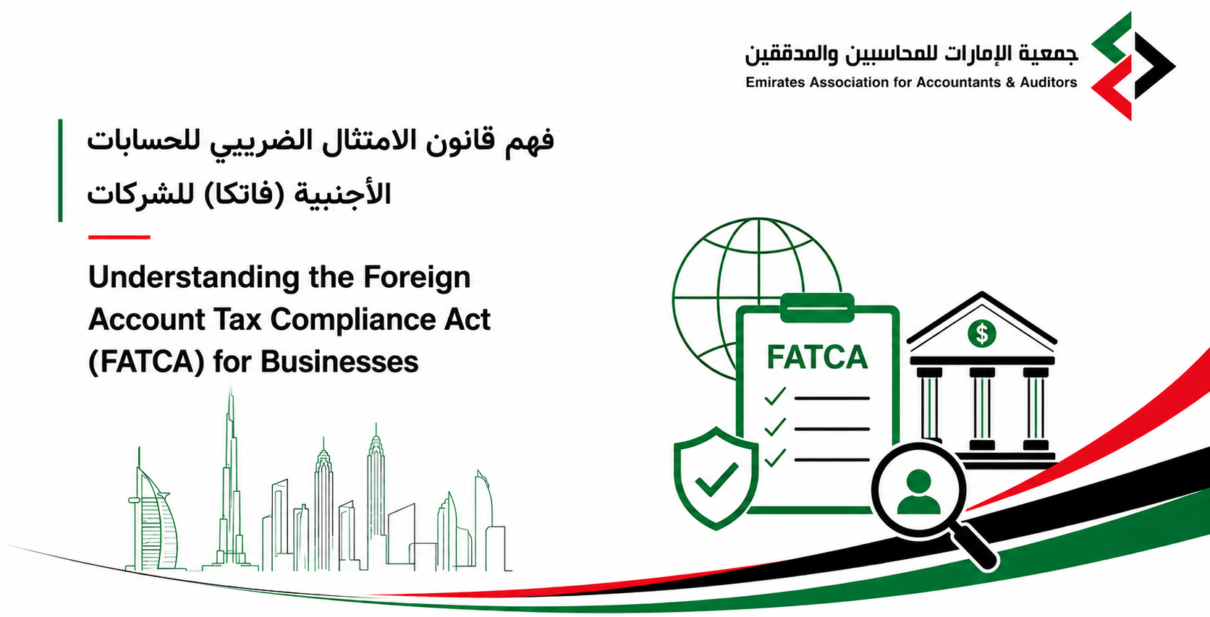
For UAE-based businesses with any exposure to US persons, US-source income, or American ownership, the Foreign Account Tax Compliance Act has become an unavoidable part of financial operations. Introduced by the United States to curb offshore tax evasion, the Foreign Account Tax Compliance Act FATCA primarily requires Foreign Financial Institutions (FFIs) to identify and report certain US accounts, while many Non-Financial Foreign Entities (NFFEs) are required to provide ownership certifications and related documentation depending on their classification. For accounting and finance professionals across the UAE, understanding the Foreign Account Tax Compliance Act is no longer optional; it is a core compliance requirement that touches banking relationships, payroll, vendor payments, and cross-border transactions.
This article breaks down what the Foreign Account Tax Compliance Act means in practice for UAE businesses, from the paperwork finance teams handle on a routine basis to the classification decisions that determine how a company is treated by banks and US counterparties. Whether a business is a small accounting practice, a multinational subsidiary, or a free zone holding company, the Foreign Account Tax Compliance Act has practical implications that are worth understanding well before a bank or client raises the question.
What is FATCA and Why Does It Matter?
The Foreign Account Tax Compliance Act, commonly known by its acronym FATCA, was enacted in the United States to increase transparency around the offshore financial activity of US citizens and residents. Under FATCA, In jurisdictions operating under a Model 1 Intergovernmental Agreement, such as the UAE, reporting is generally made through the competent local authority in accordance with the applicable IGA framework., or face significant withholding penalties on certain US-source payments.
While FATCA was originally designed with banks and investment funds in mind, its reach extends far beyond the financial sector. Any UAE business that receives payments from US counterparties, maintains US bank accounts, or has US shareholders may need to comply with foreign account tax compliance act (fatca) reporting obligations. This matters because non-compliance can trigger a 30 percent withholding tax on certain US-source payments, along with reputational risk and strained banking relationships, since most UAE banks now require FATCA self-certification as part of standard account opening procedures.
It is worth noting that the Foreign Account Tax Compliance Act operates alongside, but separately from, the OECD’s Common Reporting Standard, which the UAE also implements for broader international tax transparency purposes. Businesses sometimes confuse the two regimes, but FATCA specifically targets US tax residency and US ownership, while the Common Reporting Standard covers a much wider range of participating jurisdictions. Understanding this distinction helps finance teams avoid submitting the wrong self-certification form to their bank or misclassifying an account during onboarding.
How W-8 Forms Work in Business Tax Reporting
One of the most practical touchpoints businesses encounter under FATCA is the W-8 series of forms. These forms are used by non-US entities to certify their foreign status and, where applicable, their FATCA classification to US withholding agents, banks, and business partners. The most common version, the W-8BEN-E, is completed by entities rather than individuals and asks the business to declare its Chapter 4 status under FATCA.
Getting these forms right matters considerably, since an incomplete or incorrectly completed W-8 form can result in default withholding at the maximum rate, even if the business would otherwise qualify for a reduced rate or exemption under a tax treaty. UAE accounting teams handling US-facing transactions should treat W-8 documentation as a recurring compliance task rather than a one-time exercise, since forms typically need to be renewed every three years or whenever the entity’s circumstances change in a way that affects its FATCA status.
Businesses should also be aware that different W-8 variants exist for different purposes: the W-8BEN is used by individuals, the W-8BEN-E by entities, the W-8ECI by foreign entities claiming income is effectively connected with a US trade or business, and the W-8IMY by intermediaries. Selecting the wrong form is a common error among finance teams unfamiliar with US withholding rules, and it can delay payments or trigger unnecessary questions from US counterparties who are themselves obligated to collect valid documentation under the Foreign Account Tax Compliance Act before releasing funds.
What FATCA Status Means for Withholding Compliance
A business’s FATCA status determines how US withholding agents treat payments made to that business. Entities generally fall into one of several categories, including a participating foreign financial institution, a non-financial foreign entity, or, in more complex cases, a deemed-compliant institution under an applicable intergovernmental agreement. The UAE has its own intergovernmental agreement framework with the United States, which affects how local financial institutions register and report under FATCA.
Determining the correct FATCA status is not always straightforward, particularly for holding companies, family offices, and free zone entities that may not neatly fit into a single category. Misclassifying an entity’s status can lead to unnecessary withholding on legitimate payments or, conversely, expose the business to compliance risk if it fails to register when registration was actually required. For this reason, many UAE businesses engage accounting professionals with specific FATCA expertise to review entity structures and confirm the correct classification before signing W-8 documentation.
Family offices in particular face a layered classification challenge, since a single family group may control multiple trusts, holding companies, and operating entities, each of which may need to be assessed separately for FATCA purposes. An incorrect classification at the holding company level can cascade down to subsidiaries, creating compliance gaps that are only discovered when a bank flags inconsistent self-certification forms across related accounts during a periodic review.
Main Challenges Controllers Face With FATCA
Financial controllers across the UAE consistently report several recurring challenges when managing FATCA obligations. The first is simply keeping track of which entities within a corporate group require separate FATCA classification, particularly for businesses with multiple subsidiaries, joint ventures, or free zone entities operating under a single parent company.
The second common challenge involves ongoing monitoring. FATCA is not a one-time compliance exercise; entities must monitor changes in ownership, shareholder composition, and account activity that could shift their classification or reporting obligations over time. A business that was correctly classified at formation may find its status has changed following a change in ownership structure or a new US-based investor joining the capitalization table.
A third challenge relates to coordination between finance, legal, and external banking partners, since FATCA documentation requests often arrive from multiple directions at once, including banks conducting periodic reviews, US counterparties requesting updated W-8 forms, and auditors verifying compliance during year-end reviews. Without a clear internal process, these requests can easily fall through the cracks, resulting in delayed banking transactions or unnecessary withholding.
A fourth, less obvious challenge involves staff turnover. When the person who originally handled a company’s Foreign Account Tax Compliance Act registration and classification leaves the organization, institutional knowledge often leaves with them, particularly if the reasoning behind a specific classification decision was never documented. New finance hires are then left trying to reconstruct why an entity was classified a certain way, sometimes years after the original decision was made.
A final recurring difficulty is language and terminology. Many UAE finance teams operate bilingually across Arabic and English, and US tax terminology such as “withholding agent,” “beneficial owner,” and “Chapter 4 status” does not always translate cleanly. Controllers who invest time in building an internal glossary of these terms, aligned with how the concepts are explained during CPD and continuing education sessions, tend to onboard new staff into the compliance process more smoothly than those who rely purely on the original English-language IRS guidance.
Best Practices for FATCA Compliance Management
Businesses that manage FATCA well tend to share several common practices. They maintain a centralized register of all group entities along with their current FATCA classification and the date each classification was last reviewed. They also assign clear internal ownership of FATCA compliance, typically within the finance or tax function, rather than treating it as an ad hoc task handled whenever a bank or client requests documentation.
Regular internal reviews, ideally conducted annually or whenever there is a material change in ownership or structure, help ensure that FATCA status remains accurate and that W-8 forms are renewed before they expire. Training finance staff to recognize the practical implications of foreign account tax compliance act (fatca) reporting, rather than treating it purely as a legal technicality, also reduces the risk of errors when new team members handle US-facing payments or banking relationship renewals for the first time.
Documenting the rationale behind each entity’s FATCA status is equally important. A short internal memo explaining why a holding company was classified as a non-financial foreign entity, for example, saves considerable time when the classification is questioned later by a bank, an auditor, or a new compliance hire. Firms that build this kind of institutional memory into their compliance process tend to handle FATCA reviews far more efficiently than those relying on informal knowledge held by one or two long-serving staff members.
It also helps to set calendar reminders tied to each entity’s W-8 form expiry date, rather than waiting for a bank or counterparty to flag that documentation has lapsed. A proactive renewal schedule, reviewed quarterly alongside other compliance deadlines, prevents the last-minute scramble that often occurs when an expired form is only discovered at the moment a payment is due to be processed.
How Businesses Automate FATCA Compliance Processes
As with many areas of financial compliance, technology is playing an increasingly important role in how businesses manage FATCA obligations. Automated compliance platforms can track entity classifications, flag upcoming W-8 form renewal deadlines, and maintain a documented audit trail showing when each classification was last reviewed and by whom.
Some platforms integrate directly with banking portals, allowing businesses to respond to FATCA-related documentation requests more quickly and with greater consistency across multiple accounts and entities. This is particularly valuable for accounting firms managing dozens of client entities simultaneously, where manual tracking across spreadsheets quickly becomes unmanageable and prone to oversight. For accounting firms serving multiple UAE clients with cross-border US exposure, this kind of automation also improves scalability, since compliance staff can manage a larger portfolio of client entities without a proportional increase in manual review time. As regulatory scrutiny around cross-border tax compliance continues to increase globally, businesses that invest in structured FATCA compliance processes now are likely to face fewer disruptions to banking relationships and cross-border payments in the future.
Ultimately, the Foreign Account Tax Compliance Act is not a passing regulatory trend but a permanent feature of doing business with US counterparties or maintaining US-linked accounts. UAE businesses that build clear internal ownership, accurate documentation, and where appropriate, automated tracking into their compliance function are far better positioned to manage FATCA obligations smoothly, avoid unnecessary withholding, and maintain strong relationships with banks, clients, and regulators over the long term.
FAQ
What is the purpose of the Foreign Account Tax Compliance Act (FATCA)?
The Foreign Account Tax Compliance Act was enacted to prevent offshore tax evasion by US persons, requiring foreign financial institutions and certain non-financial entities to report information about accounts and ownership connected to US taxpayers.
How do W-8 forms relate to FATCA compliance?
W-8 forms allow non-US entities to certify their foreign status and FATCA classification to withholding agents and banks, determining whether payments received are subject to standard withholding, reduced withholding, or an exemption.
What is the impact of FATCA on payments to foreign entities?
Payments to foreign entities that fail to comply with FATCA documentation requirements can be subject to a 30 percent withholding tax on certain US-source income, along with additional scrutiny from banks and business partners.
What does Chapter 4 Status (FATCA status) mean?
Chapter 4 Status, commonly referred to as FATCA status, is the classification assigned to an entity under FATCA, such as a foreign financial institution or non-financial foreign entity, which determines its reporting and withholding obligations. Getting this classification right, and keeping it documented and up to date, remains one of the most practical steps a UAE business can take to avoid unnecessary withholding and maintain smooth banking relationships going forward.